
Intentional Bedsharing: Learning the facts and enjoying sleep with your baby
By Juliet and Lara
If you are pregnant or postpartum, you may have been told by friends, family, your midwife or doctor that it is imperative to your baby’s safety that your baby only sleep in a bassinet from birth. There is cultural pressure for your infant to sleep in long stretches on their own from a very young age; there are even products made to mechanically rock, pat, shake, or shush a baby to keep them asleep for 4 hour stretches. In this blog post, we are offering an alternative perspective: that bedsharing and frequent waking is safe and supportive of healthy feeding relationships and secure attachment. It may surprise you to learn that bedsharing is an evidence-based choice that can be beneficial to both you and your baby.
Bedsharing is defined as an infant sharing a sleep surface with another person. Bedsharing can also include siblings sharing a bed with one another, or parents sharing a bed with more than one child. It may be used interchangeably with “cosleeping”, which can mean sharing a surface or sharing a room or bedside bassinet with your infant. Here we will focus on bedsharing where a parent is intentionally sharing a sleep surface with an infant.
Almost every parent will bring their baby into their bed at some point: per a 2023 survey of 4000 participants by the Lullaby trust, 9 out of 10 parents coslept with their infant, but less than 4 of 10 participants had been offered guidance from their care providers on how to do this safely. We’d guess that the majority of these folks did not initially plan to bedshare with their baby. Plans change, circumstances change, and at the end of the day we all just want to get as good a night's sleep. The unfortunate reality is that North American culture heavily stigmatizes bedsharing and parents and parents get little to no evidence-based information about safe sleep. Instead, advice about sleep is based on fearmongering and preaching of an all or nothing approach. The message most new parents hear is that their baby should never sleep in their bed with them.
But what is the truth? The truth is most parents are going to do it (read the survey results again!). And the truth is, it is safe, so long as it is done with care and you and your baby are healthy. Not to mention the fact that it is so cozy and nice, and often gets parents the most sleep possible!
Why is Bedsharing Stigmatized?
In the last 40 years, there has been a shift in understanding of safe infant sleep. The common practice of the 1960s and 1970s in North America was stomach sleeping (yes - if you can believe it, if you were born during these decades you were probably put on your tummy to sleep as a baby!). In the 1990s, researchers studying the causes of crib death or SIDS (sudden infant death syndrome) concluded that the safest sleeping arrangement is what we refer to now as “back to sleep”; placing a sleeping infant on their back. However, evidence never concluded different SIDS outcomes for cribs versus bassinets. Therefore, the real risk factor from these studies was not a shared sleep surface, but rather suffocation from re-inhalation, which usually occurs when babies are either placed on their stomachs, have their faces covered with a blanket, or are on a sleep surface that is too soft, causing dents in the mattress that increase re-inhalation risk.
When we look at stories about infant death that occurred during bedsharing, many of the safety issues above were the reason for infant death, not bedsharing itself. For example, the Cribs for Kids ambassadors discourage cosleeping because of stories about parents who fell asleep with their child in a recliner, couch, or by accident when the bed was not intentionally set up for bedsharing. So, the real harm is not in cosleeping, but accidental or uninformed cosleeping.
If we were to go further with the reasoning behind this stigma, we also need to relate the doctrine of separate surface sleep back to Western values which prioritize hyperindependence over interdependence. When you share a surface to sleep with your child, you are likely not using tactics like “crying it out”, “self soothing” or sleep training tactics. These strategies are all rooted in the idea that we need to train an infant away from their age appropriate, physiological behaviors of frequent waking and need for human contact. Capitalism puts postpartum parents on swift recovery timelines where they are rushed to return to work (in some parts of the US, postpartum parents are expected to back to work full time at 6 weeks postpartum) and expected to bounce back, leading them to need to outsource reproductive labour, and rush their babies through important developmental stages. Hustle culture prioritises sleeping through the night before it is physiologically age appropriate and safe.
Further, the neoliberal “post feminist” framework teaches us that parents shouldn’t “waste their time” moving slowly and meeting their children where they are at. Neoliberalism doesn't have the time for the major life shift of postpartum as a slow, winding road. We are used to being able to predict timelines, measure and perform, while postpartum invites us to do the opposite: meet your infant as a human, put down the clock, and look at and be with your baby.
Why might bedsharing actually be a good idea?
Infant sleep expert Dr. James McKenna invites his readers to consider rather than discussing whether it is safe for babies to sleep with us, we should discuss whether it is really safe for babies to sleep alone. Your baby is born expecting to be held. And when we use tactics like “crying it out”, if your baby stops crying and falls asleep, it’s not because they are soothed, it’s because they are giving up. This is an unsafe attachment practice. Of course there will be times when you as a parent do not have enough hands to respond to your baby’s cries immediately, nor is that the expectation. But, when the habit becomes "training" your child to not need you for soothing, healthy attachment is deprioritized and your baby is not given the signals that you are their safe place, that you always come back, and that they can depend on you.
Bedsharing is a harm reduction tool, particularly against postpartum mental illness. Postpartum psychosis, depression, rage, and anxiety are all exacerbated by sleep deprivation in parents. If you are pulling all nighters trying to soothe your infant, your mental health will suffer. Bed sharing gets parents more sleep and also gives you opportunities to also receive the oxytocin rush of touching your baby. It is not just your baby who is born needing to be held, you need to hold your baby for your own wellbeing.
Finally, frequent waking is a measure against SIDS and a necessity for body feeding relationships. Normal newborn body feeding habits include a full feed at least 8-12 times per day, including overnight. Every time your newborn sleeps through a feed because they are being rocked by a SNOO or patted by a mechanical toy, their stomach does not get the nutrients it needs, and the body feeding the baby does not get the signal to produce more milk.
I’m sure at this point we have convinced you that bedsharing is a great idea, so, how do you do it?
What are bedsharing dos and don'ts?
DO:
Set up a firm, flat, sleep surface for you and your child
Sleep in the cuddle curl position, or a safe chest to chest position with light clothing, hair tied back, and no swaddles or sleep sacks
Cosleep if your baby is full term and healthy
Cosleep when you are sober and able to respond to your baby’s cries (no drowsy medications)
Place your baby on the outside edge of the bed, away from large pillows and blankets
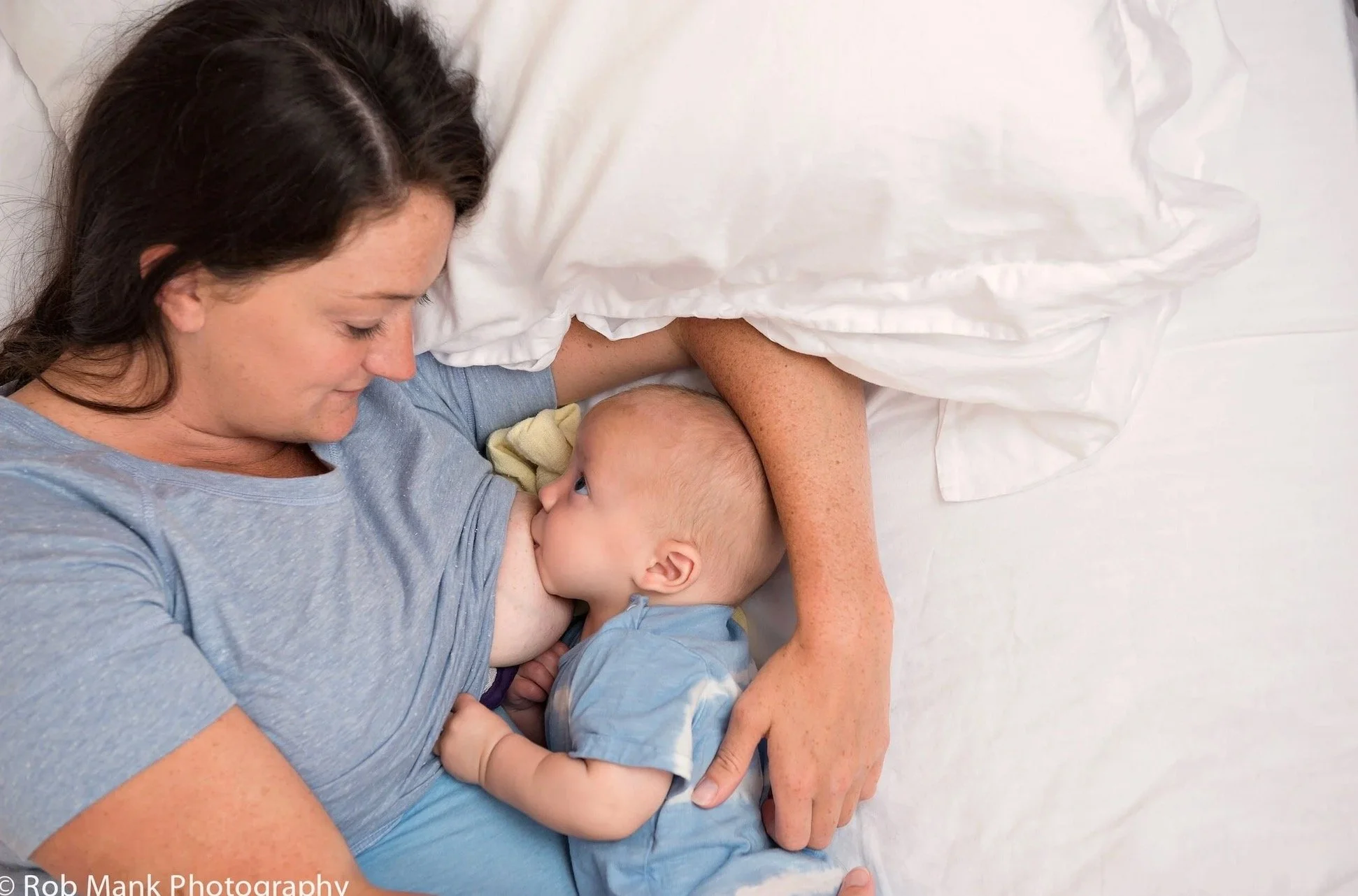
We can see here this person is lying in the cuddle curl, with their arm between their baby and the pillow. Their sleep surface is free of unnecessary pillow or blankets. The only potential hazard we can find here is that the long hair is not tied back!
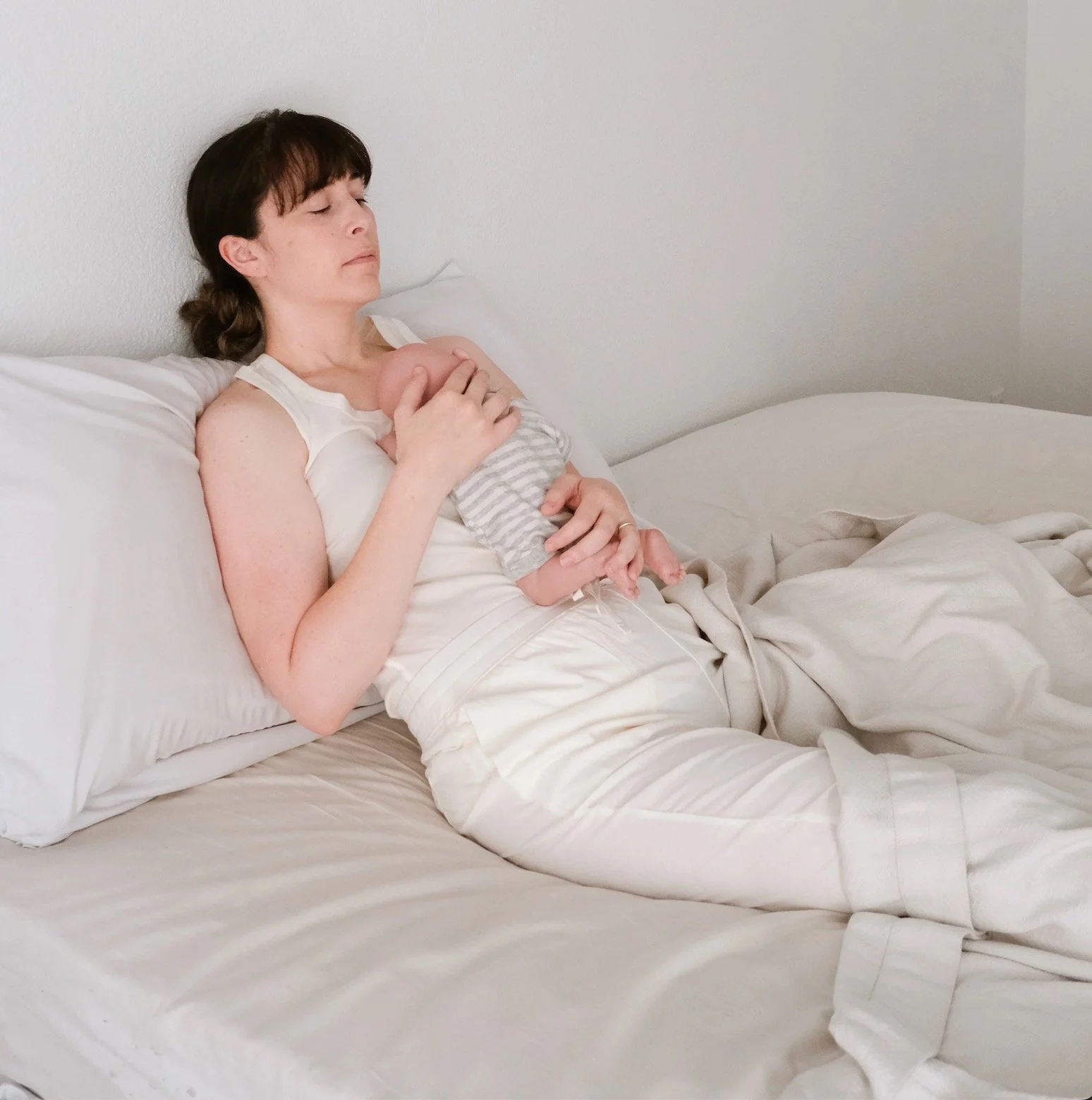
This image depicts safe chest to chest sleeping. The adult is reclined at an angle, the bed is free from unnecessary coverings, baby and parent are lightly dressed, and they are in the centre of the mattress.
DON’T
Cosleep in a recliner or on a couch
Cosleep with a carrier or stretchy wrap
Cover your baby with a blanket or swaddle
Put your baby against a wall (it may seem safer, but the corner between the wall and the bed is a suffocation hazard. Suffocation is more of a risk than rolling for newborns, If you are worried about rolling).
Cosleep after you have consumed alcohol or any drowsy medication.
Cosleep if your baby was born prematurely (before 37 weeks), has any medical issues, or is under 5.5 lbs
As your baby gets older and more mobile, there are some additional things to take into consideration. Once your baby can roll back to front, the safest recommendation is to either transition to a floor bed or add a sidecar crib to your sleep setup. If your little one is to roll off the bed at some point, they will only be a short ways to the ground if you are sharing a floor bed. Consider adding a soft rug or crib mattress beside the bed for added cushion, or lining the floor with pillows. A floor bed also offers some additional longevity in terms of safety: once your baby is crawling, if they crawl off the bed it’s less of a hazard then if they were to crawl off a higher surface, and you can teach them to get off the bed feet first. Before you know it they will be able to get in and out of bed on their own!

Lara’s sleep setup with their mobile baby. Mattress is on the floor on bed slats, both adults have separate bedding (not the light blanket for Lara) and their is a crib mattress on the floor in case baby takes a tumble.
If a floor bed is not possible, a sidecar crib can be a good alternative. It offers babies their own sleep space with three sides of railings, but still with complete access to you on the main bed. Keep in mind that if you leave your baby unattended for naps you may not wish to use this setup if your bed is raised off the ground. Some people also choose to use bumpers, bedrails, or sleep with their baby between them and a wall. Bedrails and walls can pose a risk of entrapment. To reduce this risk, you will want to pack any crevices well. With bumpers, there is a risk of baby crawling over the bumper, and once babies are pulling to stand, they could use the bedrail to pull up. Remember: you know yourself and your baby best! As babies become mobile their sleeping habits might change. When deciding how to set up your sleep space for an older, mobile baby, ask yourself:
Is my baby an active sleeper?
Do I wish to be able to leave my baby unattended in this sleep setup?
How much physical space do we have?
Do I have the mobility to use a floor bed comfortably for my own sleep?
Finally, we want to reiterate that cosleeping is a spectrum. You might cosleep with your infant every single time they are asleep for the first 2 or 3 years of their life, or you may only cosleep with them at night. You may wear them for naps during the day, or bring them into your bed during the first overnight feed. There is no such thing as too much contact and it may take many weeks or months to get into a proper sleep groove. You may feel like the only parent on the planet whose babe is waking up 3 or more times a night at 8 months old, but we assure you, you are not, and the more information out there to not only destigmatize, but celebrate this practice, the less shame and questioning we hope parents will feel around their baby’s sleep journey.
Your baby’s physiological need to be held is as important as their need for milk, rest, and diaper changes. Postpartum is a winding road. It’s a slow road, it’s a special and unique opportunity in life to connect with your existence as a living creature outside of scripts of productivity and growth. So, be with your baby. Lie with them. Nap with them, wear them, hold them when they cry. Respond to their needs. You are your baby’s entire world. That is the most special gift and you deserve the most special rest with them!
Check out Lara’s Q&A with Juliet about cosleeping with their child:
Lara: When and why should a parent learn about safe bedsharing?
Juliet: I would recommend learning about safe bedsharing during the final few months of your pregnancy: early enough that it doesn’t feel like a scramble, but not so early that the knowledge gets lost when it’s time to use it! While you might plan to never bedshare, knowing how to cosleep safely is an important tool. Safe bedsharing can help develop feeding relationships, support postpartum mental health, promote bonding, and allow for more rest. And most parents will co-sleep even if it’s not on their plan.
Juliet: Did you plan to bedshare with your baby?
Lara: Yes! We had a bassinet set up as a backup option in case we either couldn’t bedshare (for example if our baby would’ve been premature) or decided we didn’t want to. I knew that bedsharing would facilitate bonding, encourage our bodyfeeding relationship to develop and get us more sleep. We are 9+ months in and couldn’t imagine not sleeping as we do.
Lara: What are some ways that you can help parents who want to learn about safe bedsharing?
Juliet: I offer a few options. If we work together for birth or postpartum, we talk about and can practice bedsharing during prenatal sessions. I also offer a specific package tailored to sleep support. This is different from sleep training, which is usually focused on training babies away from their physiological behaviors of waking often and needing human contact to sleep and soothe. It’s about reframing normal infant behavior, because physiological infant behavior isn’t a problem to be solved.
Juliet: What are some benefits you have experienced bedsharing with your child?
Lara: More sleep, all around! In the early days, I sat up to nurse overnight, but not having to get up out of bed to pick up my baby was great. For months now, I feed my baby exclusively in side lying overnight, so I don’t get up at all. I can say with certainty that I get so much more sleep with my baby in bed with me than I would if I was getting up out of bed each time they stirred. I truly have no idea how many times I feed them overnight, as the wake ups are so brief. I also cherish the additional time I have each day to connect with and cuddle my baby.
Lara: If a parent wants to bedshare, but has no idea how to set up their space can you help?
Juliet: Yes! During our prenatal sessions, I prompt my clients to lie in bed with my doula doll in a cuddle curl and we take a look at your space setup and troubleshoot. We can address concerns about mattress firmness, moving around during sleep, sharing a bed with your baby and partner, and how to bedshare with your child once they can roll and crawl.
Juliet: If there were one thing you would want other parents to know about intentional bedsharing, what would it be?
Lara: Even though it is often heavily stigmatized in western culture, it is normal to sleep in a shared space or very near to our babies. And, almost every single parent will do it at some point! It is not something to feel shameful or guilty about. Plus, if done carefully, it is extremely safe.
About Juliet: Juliet (she/her) is a full spectrum doula living in Tkaronto (unceded Annishanabe territory). She works with families supporting birth, postpartum, abortion and loss. She’s an avid cook, cyclist, and musician. Juliet is passionate about bedsharing, babywearing, and holding parents and their little ones through transitions of all sorts You can explore her website here!
About Lara: Lara (they/them) is a queer parent and doula. They worked on this piece mainly from bed, while their baby slept beside them! Lara specializes in supporting queer & trans folks through the full spectrum of reproductive experience, from fertility and conception through to postpartum. You can connect with them here.
Sources:
https://www.nice.org.uk/guidance/ng194/evidence/n-cosleeping-risk-factors-pdf-326764485978
https://link.springer.com/article/10.1007/s12110-024-09474-6
Resources:
Safe Infant Sleep (book)
LLL Safe Sleep Seven
@cosleepy